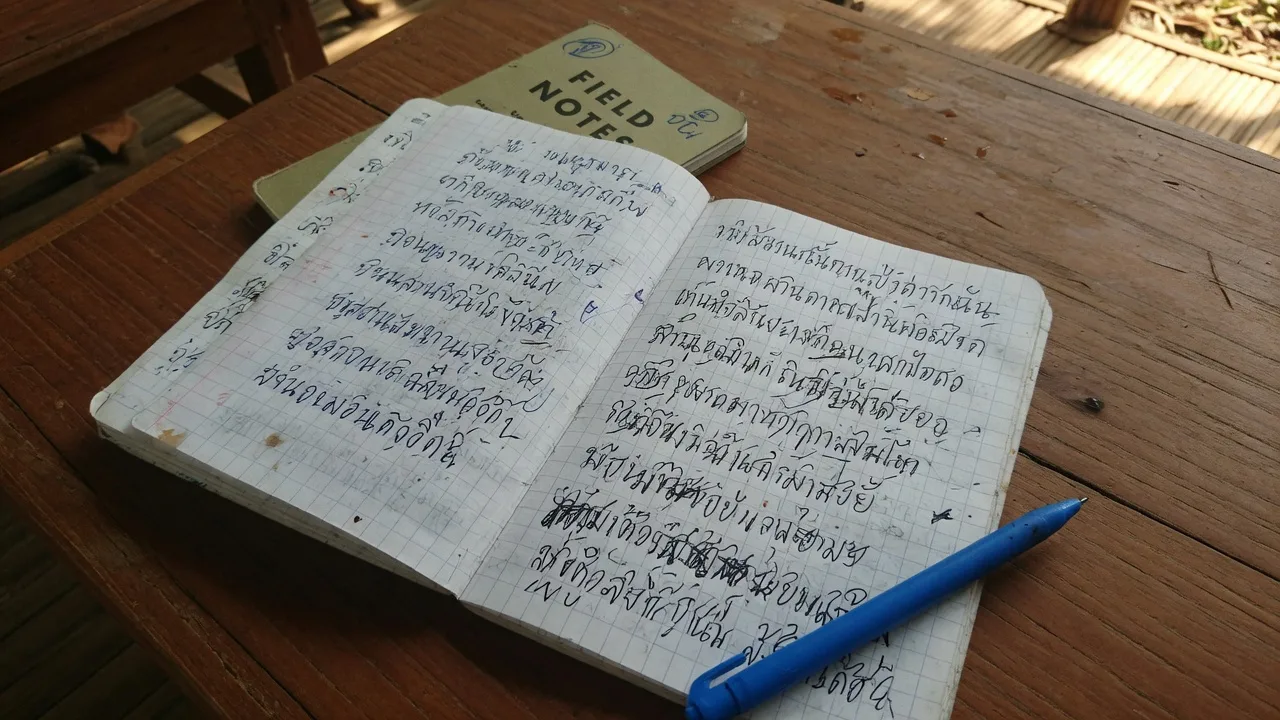
Thai (ภาษาไทย, phasa Thai) is a tonal language that can initially seem impenetrable to English speakers. Five tones, unfamiliar phonetics, and a 44-consonant script are genuine obstacles. The encouraging fact is simpler: even small efforts to speak Thai are met with disproportionate warmth. A few key phrases — delivered with a smile and the right politeness particle — will change how stalls, songthaews, and hotel desks treat you. Fluency is not the goal of a fortnight. Not sounding like a barked order is.
People & Spirit’s social codes sit under the words: Kreng jai, Thai social structure. Table & Bazaar’s ordering page is the food half: How to order.
The politeness particles: khrap and kha
Thai adds gendered politeness particles to the end of sentences — the single most important piece of polite speech you can learn in an afternoon:
- ครับ (khrap) — male speakers. Short, falling. Often sounds like “krap”.
- ค่ะ (kha) — female speakers. “Kaa” with a falling tone.
Add khrap or kha to greetings, requests, thank-yous, and replies. It is “please” and “sir/ma’am” in one syllable. Omitting it sounds abrupt, not efficient. Non-binary visitors usually pick one and stay consistent; staff will not hold a seminar.
Essential phrases

| English | Thai (phonetic) | Thai script | Notes |
|---|---|---|---|
| Hello | Sawat-dee (khrap/kha) | สวัสดี | Hello and goodbye |
| Thank you | Khop khun (khrap/kha) | ขอบคุณ | Use constantly |
| Yes | Chai (khrap/kha) | ใช่ | |
| No | Mai (chai) | ไม่(ใช่) | |
| Sorry / excuse me | Khor thot (khrap/kha) | ขอโทษ | Apologies and getting past someone |
| No problem | Mai pen rai | ไม่เป็นไร | The national shrug, used well |
| How much? | Tao rai? | เท่าไหร่? | Markets |
| Too expensive | Paeng pai | แพงไป | Smile, not a fight |
| Can you reduce? | Lot dai mai? | ลดได้ไหม? | Bargaining, once |
| Delicious | Aroi (mak) | อร่อย(มาก) | Say it when it is true |
| Spicy | Phet | เผ็ด | |
| Not spicy | Mai phet | ไม่เผ็ด | Survival |
| A little spicy | Phet nit noi | เผ็ดนิดหน่อย | The compromise they will still overshoot |
| Water | Nam | น้ำ | |
| Toilet | Hong nam | ห้องน้ำ | Literally “water room” |
| Where is…? | …yoo tee nai? | …อยู่ที่ไหน? | |
| I don’t understand | Mai khao jai | ไม่เข้าใจ | |
| Can you speak English? | Phoot phasa Angrit dai mai? | พูดภาษาอังกฤษได้ไหม? | |
| Check bill | Check bin (khrap/kha) | เช็คบิล | |
| No bag | Mai sai thung | ไม่ใส่ถุง | Declining a plastic bag |
Numbers
| Number | Thai | Phonetic |
|---|---|---|
| 1 | หนึ่ง | Neung |
| 2 | สอง | Song |
| 3 | สาม | Saam |
| 4 | สี่ | See |
| 5 | ห้า | Haa |
| 6 | หก | Hok |
| 7 | เจ็ด | Jet |
| 8 | แปด | Paet |
| 9 | เก้า | Gao |
| 10 | สิบ | Sip |
| 20 | ยี่สิบ | Yee-sip |
| 100 | ร้อย | Roy |
| 1,000 | พัน | Phan |
Numbers follow a consistent pattern: 35 = saam-sip-haa (3-10-5). Learning 1–10 plus the multipliers lets you handle a market stall and a songthaew fare. ฿20, ฿50, ฿100 notes are what you actually count. ATM strategy: Money and SIM.
The five tones
Thai has five tones that can change a word entirely:
| Tone | Description | Example |
|---|---|---|
| Mid | Flat, neutral pitch | กา (gaa) — crow |
| Low | Below normal pitch | ข่า (khaa) — galangal |
| Falling | Starts high, drops | ข้า (khaa) — slave |
| High | Above normal pitch | ขา (khaa) — leg |
| Rising | Starts low, rises | ค้า (khaa) — trade |
The classic example: mai with different tones can mean “new,” “wood,” “not,” “silk,” or “burn.” In practice, context usually saves you. Thais are used to foreigners missing tones. Do not let tones paralyse you. The effort of trying earns goodwill that a perfect app pronunciation never could.
Galangal versus a leg will not matter at immigration. It will matter slightly at a market when you wanted ginger and got a laugh. Laugh back.
The Thai script
Thai script is a Brahmic abugida (consonant-vowel system) derived from ancient Khmer. It has:
- 44 consonants (many representing the same sound but in different classes, which affect tone)
- 15 vowel symbols (combining above, below, before, or after consonants)
- 4 tone marks
- No spaces between words (spaces mark clause or sentence breaks)
- No capital letters
Learning to read Thai is a multi-month commitment. For a short trip, recognise a few signs: ห้องน้ำ (toilet), ทางออก (exit), อันตราย (danger), and the Thai numerals on price tags. Google Translate’s camera is the rest. Download the Thai pack offline before you lose airport Wi-Fi.
A Bosvision Travel Guard passport wallet, black, model BV-816B does not help you read Thai. It holds the passport and cards. About 22.5 × 13.5 cm. A different colour or model is a different listing. Visa & entry.
Where English actually works
English proficiency varies enormously:
- Bangkok: widely spoken in tourist areas, hotels, and businesses. Most signs bilingual.
- Tourist resorts (Phuket, Samui, Chiang Mai): good English in hotels, restaurants, and tourist-facing shops.
- Provincial cities: basic English in hotels and some restaurants. Limited elsewhere.
- Rural areas and Isan: very little English. A phrasebook or offline pack becomes the difference between lunch and charades.
- Young Thais: generally better English than older generations.
Translation apps
- Google Translate — Thai–English is usable in 2026. The camera feature reads signs, menus, and labels. Download offline.
- Papago — a decent alternative with good Thai support.
Do not hold the phone in a monk’s face. Do not play the spoken translation at volume on a bus. Temple etiquette.
Cultural language notes
- The wai: slight bow, hands pressed together. As a visitor you need not initiate wais; returning them to roughly the same height is polite. Do not wai the 7-Eleven cashier as theatre.
- Names: Thais have long official names and are universally addressed by nicknames (cheu len) — often English words (Beer, Bank, Fern, Boom, Ice). The receptionist called Golf is not a joke at your expense.
- Khun: Mr/Ms placed before the given name, not the surname: “Khun Somchai,” “Khun Golf.”
- Jai yen: “cool heart.” Losing your temper (jai ron, “hot heart”) is embarrassing for everyone and will not get the refund. Stay calm. Smile. Repeat the request once, quieter.
Food words that pay rent: aroi, mai phet, check bin, and the chilli-tray vocabulary on Chilli and condiments. A compact phrasebook still works when the phone is at 4%.
A working pocket list
- Sawatdee khrap/kha on entry.
- Khop khun khrap/kha constantly.
- Tao rai? then the number you heard, repeated back.
- Mai phet before the mortar starts — Som tam.
- Mai khao jai rather than nodding at a price you did not catch.
First week on the ground — airport, SIM, first wat — is First week. This page is only the words.
Next
How to order, Kreng jai, Etiquette, Temple etiquette, First week.